
 Alice Rose
 A basic white loaf is one of those things that seems almost too simple to go wrong, and yet it does, usually because the dough isn’t given enough time to rise properly, or because it’s rushed straight from mixing to the oven with only one proving stage.
This recipe uses a proper two-rise method, letting the dough develop fully before baking, which gives you a soft, even crumb rather than a dense, tight one.
It needs no special equipment beyond a loaf tin, and the actual hands-on time is minimal.
Why a Second Rise Makes Such a Noticeable Difference to the Crumb
Bread dough that’s only given one rise, straight from mixing into the tin and then into the oven, tends to produce a tighter, denser crumb, since the yeast hasn’t had enough time to fully develop and the gluten structure hasn’t relaxed properly.
A second rise, after the dough has been knocked back and shaped into the loaf tin, allows the yeast to continue working and the gluten to settle again, giving a noticeably lighter, more even texture once baked.
Knocking the dough back gently between the two rises also redistributes the yeast and releases some of the larger air bubbles that build up during the first prove, which is what leads to a more even crumb structure throughout the finished loaf rather than large, uneven holes in places.
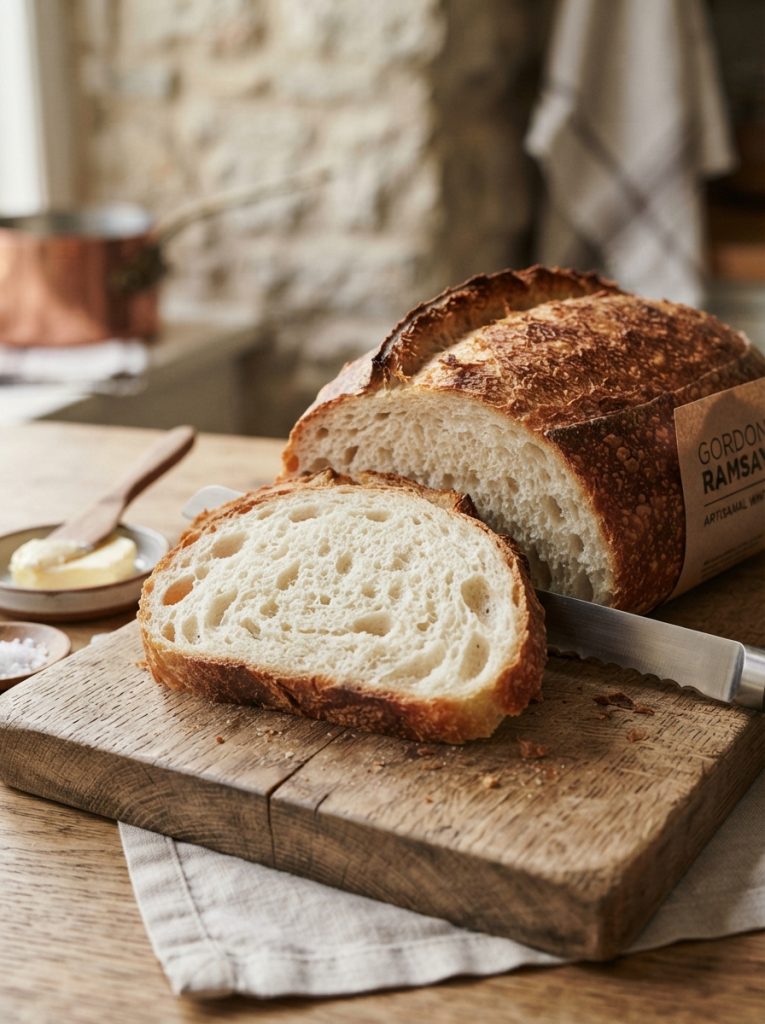
Ingredients for Gordon Ramsay White Bread
- 500g strong white bread flour, plus extra for dusting
- 7g fast-action dried yeast
- 2 tsp salt
- 1 tbsp caster sugar
- 320ml warm water
- 2 tbsp olive oil
How to Make Gordon Ramsay White Bread — Step by Step
Step 1 — Combine the Dry Ingredients
In a large bowl, mix the flour, yeast, salt and sugar, keeping the salt and yeast on opposite sides of the bowl initially.
Step 2 — Add the Wet Ingredients
Make a well in the centre and pour in the warm water and olive oil. Mix together to form a rough dough.
Step 3 — Knead
Turn out onto a lightly floured surface and knead for 8–10 minutes, until smooth and elastic.
Step 4 — First Rise
Place the dough in a lightly oiled bowl, cover with a clean tea towel or cling film, and leave in a warm place for 1–1.5 hours, until doubled in size.
Step 5 — Knock Back and Shape
Turn the risen dough out and gently knock back to release the air. Shape into a loaf and place in a greased 900g loaf tin.
Step 6 — Second Rise
Cover loosely and leave to rise again for 30–45 minutes, until it has risen above the top of the tin.
Step 7 — Preheat and Bake
Preheat the oven to 220°C / 200°C fan / Gas 7. Bake for 25–30 minutes, until deep golden and the loaf sounds hollow when tapped on the base.
Step 8 — Cool
Turn out onto a wire rack and cool completely before slicing.
My Top Tips for the Best Gordon Ramsay White Bread
Give the dough the full second rise, as skipping or rushing this step is the main reason homemade bread ends up dense rather than light.
Knead thoroughly for the full 8–10 minutes, as this develops the gluten structure that gives bread its proper texture and rise.
Check the loaf is done by tapping the base, as a hollow sound means it’s fully baked through rather than relying on colour alone.
Let the loaf cool completely before slicing, as cutting into hot bread can make it gummy and compress the crumb.
Keep the salt and yeast separated when first combining the dry ingredients, as direct contact can slow down the yeast’s activity.
Serving Suggestions
Serve fresh, sliced thickly, with butter, or toasted the next day once it’s had a chance to firm up slightly. It also makes an excellent base for sandwiches or a classic bread and butter pudding.
How to Store Gordon Ramsay White Bread
In the fridge: Not recommended, as refrigeration actually speeds up staling in bread. Store at room temperature in a bread bin or wrapped loosely for up to 3 days.
In the freezer: Freezes very well for up to 3 months, whole or sliced. Slice before freezing for easy, individual portions straight from frozen.
Gordon Ramsay White Bread Recipe
Ingredients
Method
- Mix flour, yeast, salt and sugar.
- Add water and oil, mix to a rough dough.
- Knead 8–10 minutes until smooth and elastic.
- First rise 1–1.5 hours until doubled.
- Knock back, shape, place in a loaf tin.
- Second rise 30–45 minutes.
- Bake at 220°C / 200°C fan / Gas 7 for 25–30 minutes.
- Cool completely on a wire rack before slicing.
Notes
Frequently Asked Questions About Gordon Ramsay White Bread
Why didn’t my bread rise properly?
This is usually from yeast that’s past its best, water that was too hot and killed the yeast, or not leaving the dough in a warm enough place for either rise.
Can I make this bread by hand without a stand mixer?
Yes — this recipe is written for hand kneading, though a stand mixer with a dough hook can also be used, kneading for about 6–8 minutes on a low speed.
Why is my bread dense?
This usually comes down to under-kneading, not giving the dough enough time to rise, or using too much flour, which can happen if too much extra flour is worked in during kneading.
Can I add seeds or herbs to this bread?
Yes — a handful of mixed seeds or chopped fresh herbs can be kneaded into the dough during the final stages, or scattered on top before baking.